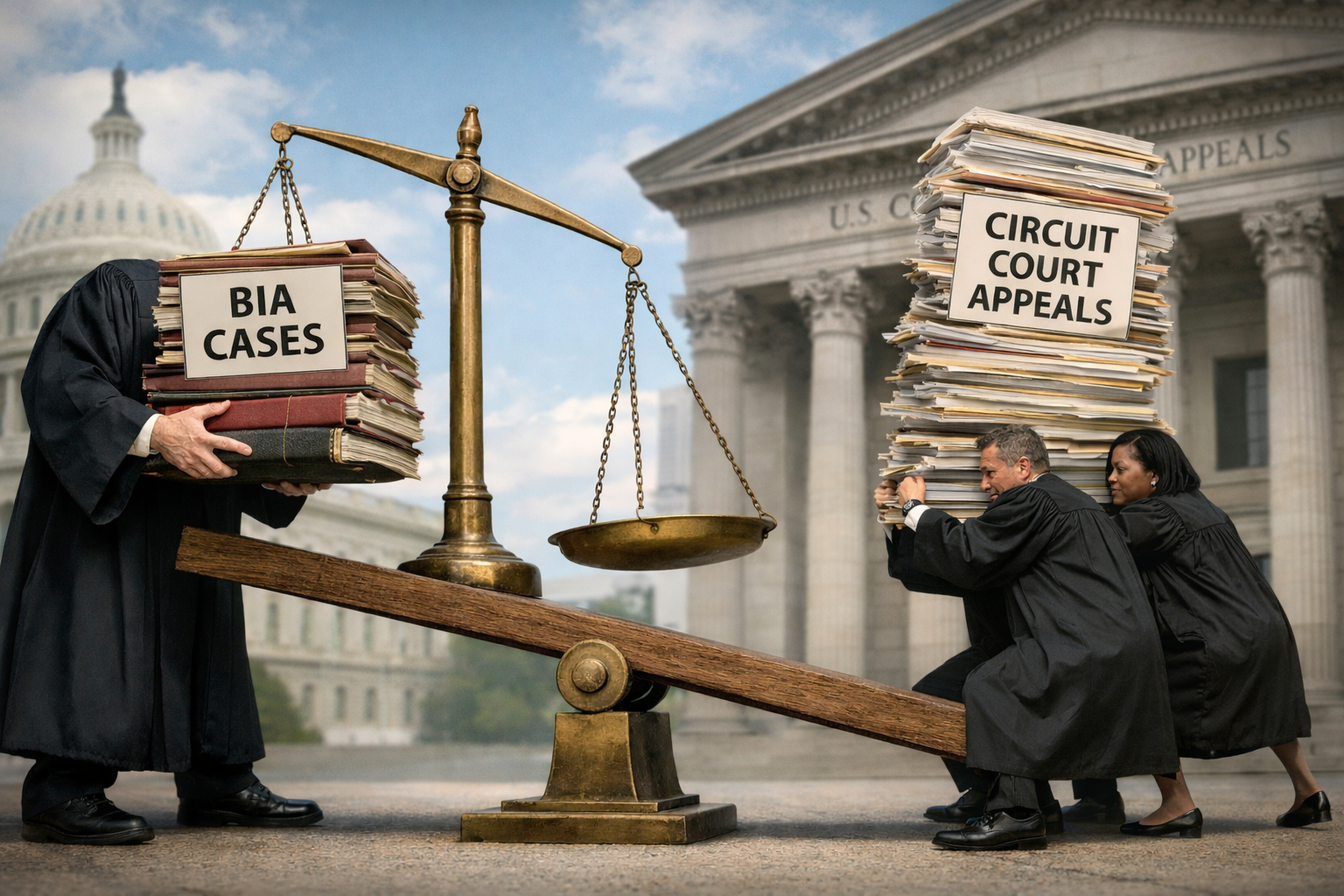
We wrote recently about the Department of Justice's interim final rule gutting BIA appellate review. That rule, effective March 2026, makes Board of Immigration Appeals review of immigration judge decisions discretionary. If the BIA declines to hear your appeal, your only option is a Petition for Review in federal circuit court. This is not the first time the government has stripped meaningful review from immigrants facing deportation. In 2002, the Justice Department did something remarkably similar. We were practicing immigration law then. We filed Petitions for Review in circuits across the country during the last great wave of BIA streamlining. We won reversals that changed the law. And we are ready for what comes next.
Understanding what happened the last time DOJ gutted immigration appeals is not just a history lesson. It is a roadmap for what is about to happen to thousands of immigration cases across the country.
The 1999 Streamlining Experiment
In 1999, Attorney General Janet Reno introduced "streamlining" reforms to manage a surging BIA caseload. The final rule (64 FR 56135, October 18, 1999) authorized a single Board member to affirm an immigration judge's decision "without opinion" in straightforward cases. The order itself, set out at 64 FR 56141, was three sentences: "The Board affirms, without opinion, the result of the decision below. The decision below is, therefore, the final agency determination. See 8 CFR 3.1(a)(7)." No analysis. No explanation. No engagement with the arguments raised on appeal.
The stated rationale was efficiency. The BIA had roughly 28,000 new cases in 1998, and the multi-layer draft and review process was lengthy. Affirmance without opinion, known as an AWO, was meant to let the Board "concentrate its resources on cases where there is a reasonable possibility of reversal, or where a significant issue is raised in the appeal." 64 FR 56135, 56138 (Oct. 18, 1999). It was also meant to reduce years-long delays. For the first eighteen months, two memoranda from BIA Chairman Paul W. Schmidt (S-L 99-11, August 28, 2000, and S-L 99-13, November 1, 2000) limited AWOs to narrow categories: purely legal issues, untimely motions, certain aggravated-felony cases, and time-barred relief claims. Three-member panels still heard most appeals. The experiment appeared contained.
Then They Expanded It
It did not stay contained. By 2001, single-member review handled over 58% of new BIA appeals. On August 26, 2002, Attorney General Ashcroft published a comprehensive final rule (67 FR 54878) that expanded single-member authority and made AWOs mandatory. The rule changed "may" to "shall": a Board member was now required to issue an AWO whenever the regulatory criteria were met. Under 8 C.F.R. § 1003.1(e)(4)(i), a Board member shall affirm without opinion when the immigration judge's result is correct, any errors are harmless or nonmaterial, and either the issues on appeal are squarely controlled by existing Board or federal court precedent, or the factual and legal issues are not so substantial that the case warrants a written opinion. Those last two conditions are alternatives, not a pair of requirements.
The practical effect was immediate. Any case squarely controlled by precedent, and any case the Board did not think substantial enough for a written opinion, became an automatic rubber stamp. The Board member's discretion to write reasons in qualifying cases was eliminated entirely. Tens of thousands of appeals were disposed of with that boilerplate order. No new legal analysis. No engagement with the specific facts of any individual case. Just: affirmed. Next.
The Federal Courts Got Flooded
What happened next was predictable. Appeals to the federal circuit courts nearly doubled from 2002 to 2003. Immigrants who received AWOs had no choice but to file Petitions for Review in the circuit courts, because the BIA had given them nothing to work with. The immigration judge's opinion, sometimes hastily written after a long merits hearing, became the only "reasoned agency decision" for the circuit court to review.
Critics charged that AWOs deprived immigrants of meaningful review and shifted enormous burdens to the courts of appeals. The Fifth Circuit described the rule plainly: "The regulation explicitly prohibits Board Members from including in their orders their own explanation or reasoning." Soadjede v. Ashcroft, 324 F.3d 830, 832 (5th Cir. 2003). The American Immigration Lawyers Association warned that the procedure prioritized speed above due process.
Every Circuit Upheld AWOs. That Did Not Make Them Right.
Despite these concerns, every federal circuit that addressed the question upheld AWOs as constitutionally permissible. The Ninth Circuit joined its sister circuits in Falcon Carriche v. Ashcroft, 350 F.3d 845, 852 (9th Cir. 2003), concluding that the BIA "did not violate the Carriches' due process rights by streamlining their appeal." That same opinion held the court had no jurisdiction to review the decision to streamline, and it expressly reserved whether streamlining is proper in cancellation of removal cases that turn on hardship. The First Circuit had reached the question first, holding in Albathani v. INS, 318 F.3d 365 (1st Cir. 2003), that immigrants have no due process right to a BIA written opinion. The Third Circuit followed in Dia v. Ashcroft, 353 F.3d 228 (3d Cir. 2003) (en banc). The Second, Fifth, Sixth, Seventh, Tenth, and Eleventh Circuits reached the same conclusion in rapid succession: Zhang v. U.S. Dep't of Justice, 362 F.3d 155 (2d Cir. 2004). The Fourth Circuit took up streamlining on a different theory and rejected the argument that it was impermissibly retroactive. Khattak v. Ashcroft, 332 F.3d 250, 253 (4th Cir. 2003). The other circuits followed: Soadjede v. Ashcroft, 324 F.3d 830 (5th Cir. 2003); Denko v. INS, 351 F.3d 717 (6th Cir. 2003); Georgis v. Ashcroft, 328 F.3d 962 (7th Cir. 2003); Tsegay v. Ashcroft, 386 F.3d 1347 (10th Cir. 2004); Mendoza v. U.S. Att'y Gen., 327 F.3d 1283 (11th Cir. 2003).
The legal consensus was unambiguous: neither the INA nor the Constitution guarantees an immigrant a written explanation from the BIA. The 2019 final rule (84 FR 31463) formally codified this understanding, stating that the regulations providing for an AWO, a single-member opinion, or a three-member panel opinion "are not intended to create any substantive right to a particular manner of review or decision."
But the fact that something is constitutional does not make it just. Thousands of immigrants lost their only meaningful chance at review because a single Board member checked a box instead of reading their brief.
2026: They Are Doing It Again
On February 6, 2026, the Department of Justice published an interim final rule that goes further than anything since 2002. Under the new rule, BIA review of immigration judge decisions is no longer automatic. It is discretionary. Only a BIA majority vote grants review. If the Board declines to hear your appeal, the immigration judge's decision stands, and your only recourse is a Petition for Review in federal circuit court.
This is the 2002 streamlining playbook taken to its logical extreme. In 2002, the BIA at least reviewed every case, even if it rubber-stamped the result with a boilerplate AWO. Under the 2026 rule, the BIA may not review your case at all. The practical effect will be the same as it was twenty-four years ago: a massive surge in Petitions for Review filed in the federal circuits, brought by immigrants who were denied any meaningful administrative review.
Advocates have already warned that this rule will disadvantage asylum seekers and force more litigation in the federal courts of appeals. If history is any guide, they are right. The last time DOJ streamlined BIA review, circuit court filings nearly doubled in a single year. There is no reason to expect a different outcome this time.
We Have Done This Before
Our founding attorney, Joshua Bardavid, was practicing immigration law when the 2002 streamlining reforms hit. He filed Petitions for Review in circuits across the country during the wave of AWOs that followed. He is admitted to federal circuit courts of appeals across the country and has handled well over 1,000 Petitions for Review over the past two decades.
The results speak for themselves. In Tian-Yong Chen v. U.S. INS, 359 F.3d 121 (2d Cir. 2004), the Second Circuit found the BIA's decision "fatally flawed" for ignoring testimony from a Catholic persecution victim. In Jian Tao Lin v. Eric H. Holder, Jr., 611 F.3d 228 (4th Cir. 2010), the Fourth Circuit held that the agency abused its discretion by basing an adverse credibility determination on unrelated facts from another case. In Baidis v. Lynch (2d Cir.), we won a novel ruling on stateless non-U.S. citizen protections. In Lugo v. Holder (2d Cir.), the court identified a circuit split on moral turpitude that the BIA had refused to address. In Jahjaga v. Att'y Gen., 512 F.3d 80 (3d Cir. 2008), we obtained a precedential ruling that immigrants have a right to proper service of BIA decisions.
Every one of these was a Petition for Review. Every one challenged a BIA decision in federal court. This is what we do.
What This Means for Your Case
If the BIA has denied your case, or if you expect a denial under the new rules, you have 30 days from the date of the final order of removal to file a Petition for Review in the appropriate federal circuit court. 8 U.S.C. § 1252(b)(1). In most cases that order is the BIA's decision, but not always. In Riley v. Bondi, 606 U.S. 259 (2025), the Supreme Court held that a BIA order in a withholding-only proceeding is not a final order of removal, so in those cases the clock started earlier. The Court also held that the 30-day deadline is a claims-processing rule rather than a jurisdictional bar, which is no reason to file late. Treat the deadline as absolute and call us the day the order arrives.
A Petition for Review is not a do-over. It is a legal challenge to the BIA's decision (or, in AWO cases, the immigration judge's decision) on questions of law, on constitutional claims, and on whether the agency's factual findings hold up against the record. Findings of fact are "conclusive unless any reasonable adjudicator would be compelled to conclude to the contrary." 8 U.S.C. § 1252(b)(4)(B). The narrower rule that confines review to constitutional claims and questions of law, 8 U.S.C. § 1252(a)(2)(D), applies only where another provision bars review, such as certain discretionary decisions and certain criminal grounds. It requires identifying specific legal errors in the administrative record, briefing the issues to a panel of Article III judges, and often filing an emergency motion for a stay of removal to prevent deportation while the court considers your case.
This is not something a notario can do. It is not something Google will teach you at 2am. It is not something to entrust to a lawyer who has never argued in the circuit courts. Federal appellate practice is a different world from immigration court, and the stakes could not be higher.
We have filed well over 1,000 Petitions for Review. We are admitted to every federal circuit in the country. We have won reversals that changed immigration law. The 2026 rules are about to create the largest wave of federal immigration appeals since 2002, and we have been preparing for this moment for over twenty years. If the BIA denied your case and you do not know what to do next, call us. We have been exactly where you are, well over a thousand times before.
Written by
Joshua E. Bardavid
Immigration attorney at Bardavid Law, P.C. with years of experience helping clients navigate the U.S. immigration system.