On Tuesday, a government attorney stood before a federal judge in Minnesota and said something that captures everything wrong with immigration detention in America right now. Julie Le, assigned to defend ICE's detention of immigrants swept up in "Operation Metro Surge," told Judge Jerry Blackwell: "What do you want me to do? The system sucks. This job sucks. And I am trying every breath that I have so that I can get you what you need."
Then she added: "Sometime I wish you would just hold me in contempt, Your Honor, so that I can have a full 24 hours of sleep."
She was removed from her post within hours. But firing one exhausted attorney does nothing to address what her breakdown reveals: the government is detaining people at a scale so far beyond what the law permits that its own lawyers cannot keep up, its own agencies cannot comply with court orders, and its own facilities cannot safely hold the people it has seized.
The Numbers Tell the Story
Julie Le was assigned 88 cases in less than a month. She told the judge she had "stupidly" volunteered to help the U.S. Attorney's Office respond to the flood of habeas corpus petitions pouring in from people challenging their detention. She received no proper training. She struggled to ensure ICE complied with court orders, "which they have not done in the past or currently."
How badly has ICE failed to comply? Chief Judge Patrick Schiltz of the U.S. District Court for Minnesota released an appendix to a court order listing 74 cases with 96 separate violations of court orders in January alone. These are not paperwork errors. These are federal judges ordering ICE to release people or produce documents, and ICE simply ignoring them.
The U.S. Attorney's Office in Minnesota had 70 assistant U.S. attorneys during the previous administration. It now has as few as 17. Six prosecutors, including senior officials, resigned earlier this month in protest over the handling of the investigation into the fatal shooting of Renee Good by an immigration agent. The lawyers tasked with defending the government's detention regime are fleeing, burning out, or publicly admitting the system is indefensible.
Warehouses for Human Beings
The government's inability to defend its detentions in court coincides with its inability to safely and humanely detain people at this scale. The administration is purchasing warehouses across the country and converting them into immigration jails in what could be the largest expansion of detention capacity in American history. Two warehouses alone cost $172 million. A planned facility in El Paso could hold 8,500 people, making it among the largest jails of any kind in the country.
Converting a warehouse into a place where human beings are held against their will is not like converting a warehouse into office space. Detention facilities require specialized infrastructure: transportation access, water, sewer, medical care, emergency services, adequate staffing. Facilities specialists warn that existing medical and human services infrastructure in many locations is insufficient to support large detainee populations. The strain on local resources will be immense.
At least two of the facilities being considered are former correctional centers with established histories of violence, sexual abuse, and corruption. In just the first three weeks of 2026, six people have died in ICE custody. Plans for detention centers in nearly two dozen communities have sparked protests over suitability and proximity to homes and schools. Some warehouse owners have refused to sell to ICE under pressure from advocates. Kansas City passed a moratorium on non-city-run detention facilities.
The message is clear: the government is racing to expand its capacity to lock people up faster than it can ensure those people will be safe, faster than it can staff the facilities, and faster than it can defend the detentions in court.
A Judge Reminds the Government of Basic Civics
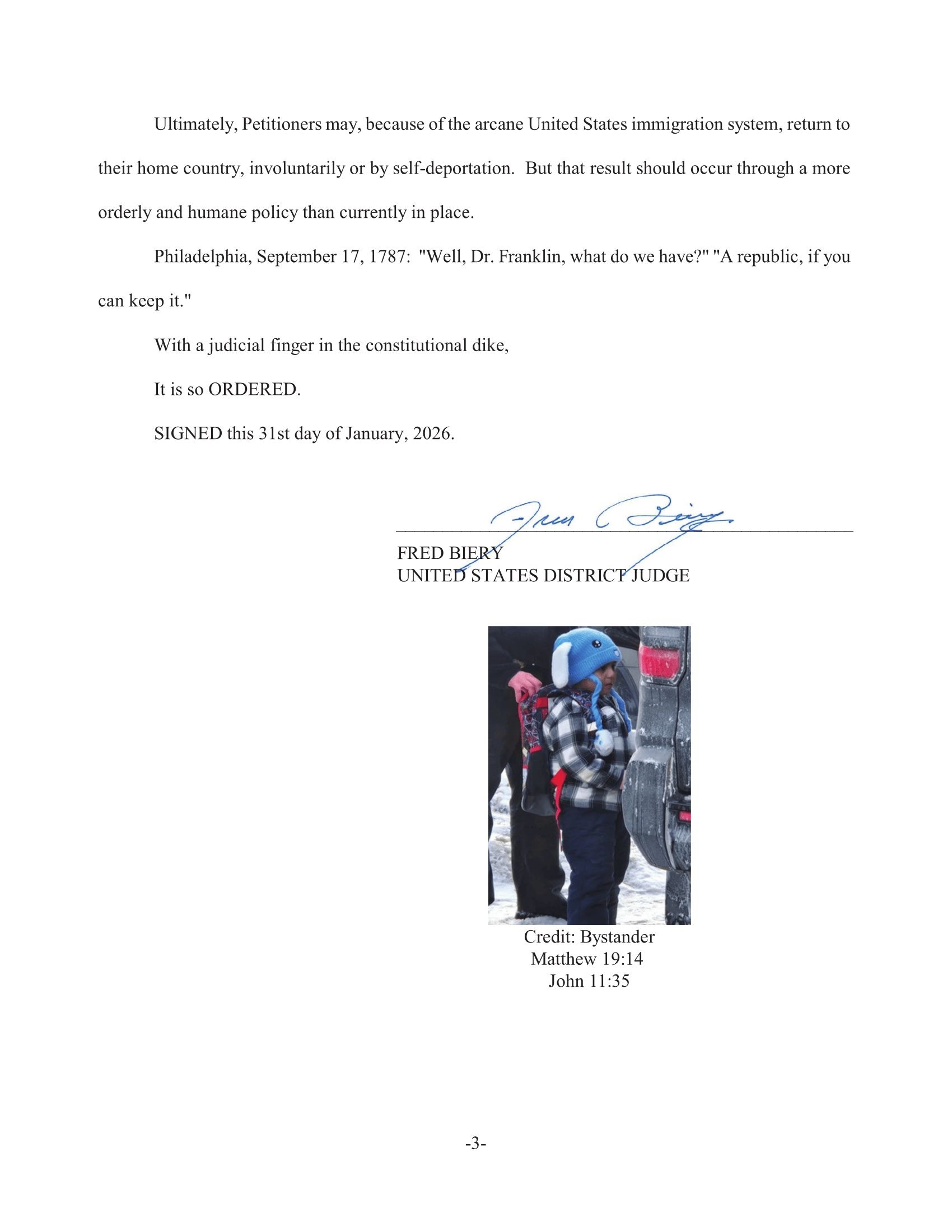
The courts have not been silent. In Texas, Judge Fred Biery issued a ruling ordering the release of five-year-old Liam Conejo Ramos and his father from ICE detention. The ruling is a masterclass in judicial eloquence, and it deserves to be read in full. But certain passages demand attention.
Judge Biery wrote that "the case has its genesis in the ill-conceived and incompetently-implemented government pursuit of daily deportation quotas, apparently even if it requires traumatizing children." He chastised "the government's ignorance of an American historical document called the Declaration of Independence," citing four grievances against King George III that read like a description of current enforcement tactics: "He has sent hither Swarms of Officers to harass our People" and "He has excited domestic Insurrection among us."
On the question of administrative warrants, Judge Biery delivered a civics lesson: "Administrative warrants issued by the executive branch to itself do not pass probable cause muster. That is called the fox guarding the henhouse. The Constitution requires an independent judicial officer."
He observed that "for some among us, the perfidious lust for unbridled power and the imposition of cruelty in its quest know no bounds and are bereft of human decency." His conclusion was unequivocal: "The Constitution of these United States trumps this administration's detention" of the petitioners.
Judge Biery closed his ruling with a photograph of five-year-old Liam in his blue snow hat, citations to the Gospel of Matthew ("Let the little children come to me, and do not hinder them") and the Gospel of John ("Jesus wept"), and Benjamin Franklin's warning upon the founding of the republic: "A republic, if you can keep it."
The Tools We Have: Habeas Corpus and Mandamus
The flood of cases overwhelming government attorneys in Minnesota are primarily habeas corpus petitions. The Latin phrase means "you have the body," and the writ of habeas corpus is one of the oldest legal protections against unlawful imprisonment. It predates the Constitution. It was enshrined in Magna Carta. It allows a person held in custody to challenge the legality of their detention before a neutral judge.
When you file a habeas petition, you are asking a federal court to examine whether the government has lawful authority to hold you. If they do not, the court orders your release. This is precisely what Judge Biery did for Liam Ramos and his father. It is what courts across the country are being asked to do hundreds of times as ICE detains people without proper legal basis.
A mandamus petition is a related but distinct tool. "Mandamus" means "we command." It is used to compel a government agency to perform a duty it is legally required to perform but has failed to do. When USCIS unreasonably delays adjudicating an application, when ICE refuses to comply with a court order, when an agency simply ignores its obligations, a mandamus petition asks the court to order the agency to act.
These are the primary weapons available to challenge unlawful detention and government inaction. They force the government into court. They require government attorneys to defend the indefensible. They create the conditions where an overwhelmed attorney admits, on the record, that the system sucks and she cannot get ICE to follow the law.
Why This Fight Matters
The government would prefer that none of this happen in public. It would prefer to detain people in warehouses far from population centers, process them quickly, and deport them before anyone files a petition. Every habeas case that lands on a federal judge's desk is a case where the government must explain itself. Every mandamus petition is a demand that the government do its job according to the law.
The courts are not a perfect remedy. Judges can be overruled on appeal. The government can change tactics. But right now, federal courts are the primary arena where the lawlessness of mass detention is being exposed and, case by case, held accountable. Judge Biery's ruling in Texas, the 96 violations documented in Minnesota, the attorney who admitted she cannot get ICE to follow court orders: these are all products of litigation pressure.
This is why we exist. This is why we file habeas petitions. This is why we pursue mandamus relief. The government has made clear that it will detain as many people as it can, as fast as it can, in whatever facilities it can acquire, regardless of whether it has the legal authority, the staffing, or the infrastructure to do so safely and lawfully. The only force capable of holding ICE's feet to the fire is the federal judiciary, and the judiciary only acts when lawyers bring cases before it.
What You Can Do
If you or someone you know has been detained by ICE, time is critical. The government moves fast precisely because it does not want cases to reach a courtroom. A habeas petition filed promptly can mean the difference between release and deportation to a country where someone faces persecution.
If you have a pending application that has been unreasonably delayed, a mandamus petition may be able to force the government to act. Agencies count on applicants giving up or waiting indefinitely. Litigation changes that calculation.
The government's own attorney admitted the system is overwhelmed and failing. The facilities being built cannot safely hold the people being detained. The courts are the battleground. We are here to fight.
ලියන ලද්දේ
Joshua E. Bardavid
Immigration attorney at Bardavid Law, P.C. with years of experience helping clients navigate the U.S. immigration system.